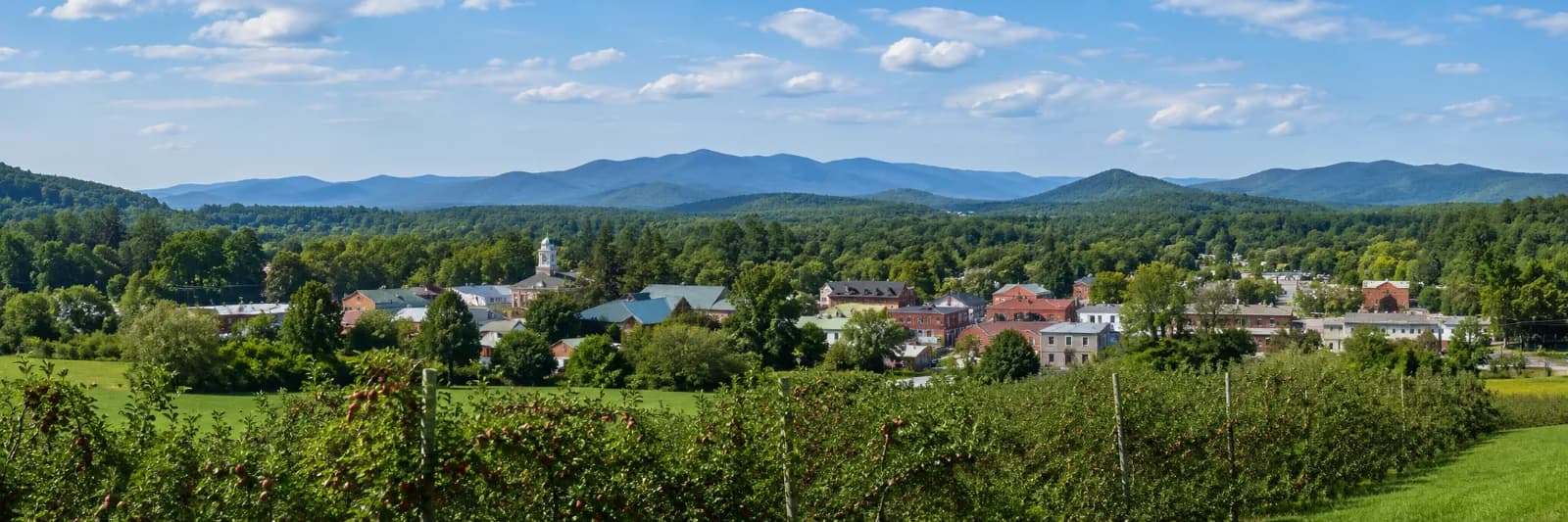

Before the Apples: Ellijay, Fort Hetzel, and the Trail of Tears
Long before it was a county seat, Ellijay was a Cherokee community at the meeting of two rivers. The story of how it was taken — at a stockade called Fort Hetzel — is one of these mountains' most painful chapters.
Ellijay Community Staff
Long before Ellijay was a county seat or an apple town, it was a Cherokee community at the meeting of two rivers. The story of how that community was taken from this land — here, at a stockade called Fort Hetzel — is one of the most important, and most painful, chapters in the history of these mountains.
- Before removal: A Cherokee village stood at the confluence of the Ellijay and Cartecay rivers; about 415 Cherokee lived along the two rivers in 1835
- The stockade: Fort Hetzel, built in 1837 in present-day East Ellijay
- The removal: 884 Cherokee were captured and marched from Fort Hetzel between May 26 and June 24, 1838
- Today: A historical marker stands in East Ellijay; the Cherokee endure as living nations
A Cherokee homeland
The name “Ellijay” itself is Cherokee. In the 1830s this was a traditional, self-sufficient mountain community — some 37 families farming the bottomlands along the Ellijay River and 23 households along the Cartecay, growing what they needed on the fertile ground between the ridges. Among the area’s leaders was Chief White Path (Nunnatsunega), a War of 1812 veteran born near Ellijay around 1761, known for resisting pressure on the Cherokee to abandon their traditions.
The Treaty of New Echota
In December 1835, a small faction of Cherokee — not the elected leadership — signed the Treaty of New Echota, surrendering all Cherokee land east of the Mississippi. Principal Chief John Ross and the National Council fiercely opposed it, but the U.S. Senate ratified the treaty by a single vote, and it became the legal pretext for removal.
Fort Hetzel
In 1837 the U.S. Army built a removal stockade near the Ellijay–Cartecay river junction and named it Fort Hetzel. In the early summer of 1838, soldiers fanned out from the fort to seize Cherokee families from their homes and fields, often allowing them only what they could carry. Between May 26 and June 24, 1838, 884 Cherokee people were captured and removed from Fort Hetzel — among the highest counts of any removal fort in Georgia. The commanding officer later admitted he had deliberately broken up families to force surrenders, and the belongings left behind were carted off and sold.
The Trail of Tears
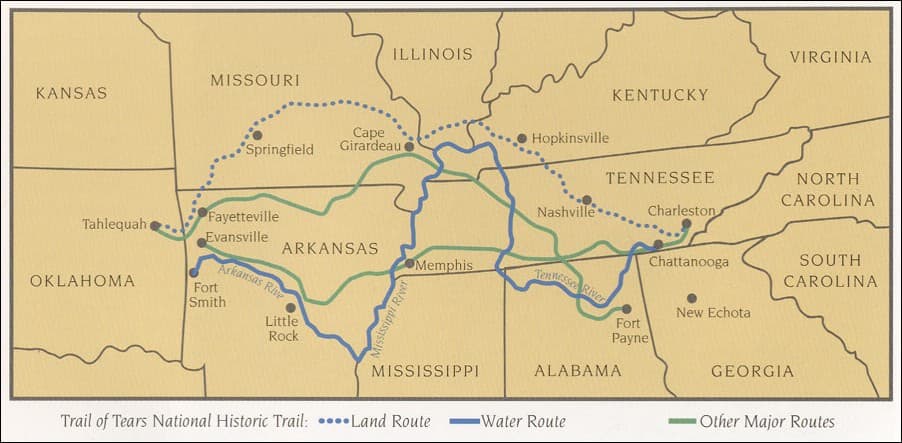
From staging camps, the captives were forced west on the roughly 1,200-mile journey that the Cherokee remember as the Trail of Tears. Estimates of the dead vary, but around 4,000 Cherokee are believed to have died from exposure, disease, and starvation. Chief White Path, who had been in Washington with John Ross during the roundup, died on the trail in November 1838 near Hopkinsville, Kentucky; the site is now part of a Trail of Tears commemorative park.
Remembering
A historical marker in East Ellijay, near the corner of Georgia Highway 515 and First Avenue, recalls Fort Hetzel and the removal it served; another marks the home of Chief White Path. The Cherokee were not erased: their descendants endure today as the Cherokee Nation, the United Keetoowah Band, and the Eastern Band of Cherokee Indians. It is worth noting, too, that the county itself is named for George Gilmer, a Georgia governor who was among the architects of that removal.
Timeline
Cover image: map of the Trail of Tears routes, National Park Service (public domain), via Wikimedia Commons. Sources include the scholarly study “Cherokee Removal Scenes: Ellijay, Georgia, 1838” (Southern Spaces), the New Georgia Encyclopedia, the National Park Service, and the Gilmer County Historical Society.
Continue this story for free.
Stay informed about Ellijay Georgia. Enter your email to access the full story and receive local news and community updates.
Free to read · No password to remember
New here? We’ll email you a sign-in link and code. Already a reader? Use your usual email.
Read next
From Cherokee Homeland to Apple Capital: A Short History of Ellijay, Georgia
Long before it became the Apple Capital of Georgia, Ellijay was a Cherokee town at the meeting of two rivers. Here is how a Blue Ridge mountain crossroads became the community we know today.
Read the story ↗

Comments
What does this mean for your neighborhood? Share your experience or ask a question.
Your draft stays here while you sign in. Be respectful and keep it local.
No comments yet. Be the first to share your thoughts!